Morning! 😃 ☕️
Almost everything is gone today.
Don't panic when you see the blanks - the sentence is in there. Take a breath, picture the cold coffee and the missed bus, and let the words come back on their own.
If you can rebuild it today, tomorrow will feel easy.
In today's email...
-
📱 Day 4: Mostly blanks - trust your memory
-
🗣️ Nasal vowels: the sound that makes French sound French
-
🌟 Where you'll actually use this phrase first
-
🏃♂️ The little connector word that makes you sound fluent
MEMORIZE 🧠
____ ____ le ___ ce _____. Mon ____ est _____. ____ je ______ et je ___ : _____ __ ___.
As always, the answer key and audio are at the bottom of this email.
SAY IT LIKE A LOCAL 🗣️
Two of today's blanks - matin and mon - hide the sound that gives French its whole flavour: the nasal vowel.
The rule most learners never get told: you do not pronounce the N. The N is an instruction, not a sound. It tells you to send the vowel up through your nose and then stop.
-
matin → "mah-TAN", where that TAN has no N at the end at all. It's the vowel in the middle of croissant, held in your nose.
-
mon → "mohn", same trick. Lips rounded, air through the nose, no consonant to finish.
Test it with a finger pinched on your nose: if the sound dies, you're doing it right. If it keeps ringing clean, you're saying an English "man."
And once more, the sentence's hinge: mais → "meh." One short, open beat.
CULTURAL MOMENT 🥐
Let's get practical: where will you actually say this first?
Probably not in Paris. Probably at home, this week, in English company - and that's exactly right. The French don't rehearse phrases in a vacuum; they attach them to moments. So borrow the habit. Printer jams? C'est la vie. Coffee goes cold while you answer one more email? C'est la vie.
Each time you attach the phrase to a real moment, you're doing what memory researchers call encoding in context - and what the French would simply call living.
By the time you do stand in a Paris café and the waiter tells you they're out of croissants, the sentence won't be something you remember. It'll be something you say.
WORD SPOTLIGHT 🔍️
Today's spotlight: the two small words that glue French together.
Mais ("meh") means "but" - and it's the hinge of our whole paragraph. Bad morning, mais we smile. You'll hear mais constantly in spoken French, often stretched out for drama: maiiis non ! Learn it once, hear it forever.
Froid ("frwah") means "cold." Mon café est froid (my coffee is cold), il fait froid (it's cold out). That second one - il fait froid - is your ready-made small talk for every Paris winter conversation.
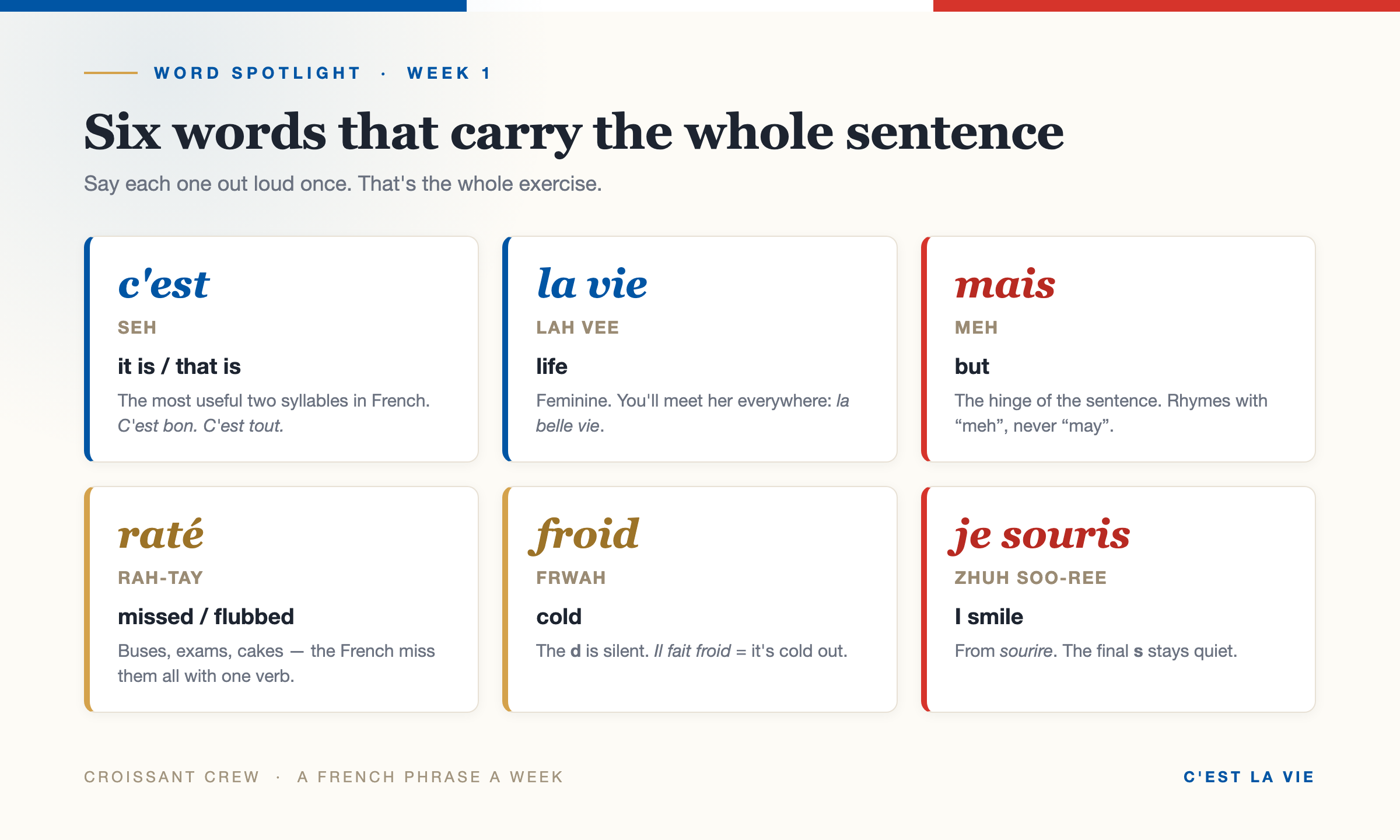
Six words. You've met every one of them this week.
COMMON MISTAKE ⚠️
Never say "je suis froid" for "I'm cold." It's the most reliably funny error in the language: it doesn't describe your temperature, it describes your personality - cold, distant, unromantic. What you want is j'ai froid, literally "I have cold."
French does this a lot. Hunger, thirst, fear, age - you have them, you don't be them: j'ai faim, j'ai soif, j'ai peur, j'ai 40 ans. Objects, though, genuinely are cold: mon café est froid is exactly right, which is why the sentence you've been memorising uses est and not a.
And the small one: mais rhymes with "meh," not "may." "May" is mai, the month.
IN THE WILD 🎬
Mais is the word French speakers reach for when they're about to disagree with you politely - and maiiis non ! (drawn out, half-laughing) is the everyday way to say "oh come on, no." Once you hear it, you'll hear it in every French conversation for the rest of your life.
USE IT TODAY 🎯
You're one day from the finish. Make these count:
-
Pinch your nose and say ce matin five times until the vowel dies in the right place.
-
Next time you're cold, say j'ai froid out loud - and feel yourself not saying "je suis froid."
-
Rebuild the entire sentence from the blanks above before you scroll. If you get ten of twelve, tomorrow is already won.
HEAR THE FRENCH 🥐
[OWNER: native audio file - reuse the week's native recording of the full MEMORIZE paragraph via the Beehiiv audio block]
Pro tip: Listen three times.
Once for general meaning.
Once following along with the text.
Once with your eyes closed, focusing purely on pronunciation and rhythm.
PRACTICE WITH MARGOT 💬
Ready to stretch? Ask Margot for a fresh situation to use c'est la vie in - she'll set the scene and let you land the phrase yourself. Try one with her.
ANSWER KEY ✅
J'ai raté le bus ce matin. Mon café est froid. Mais je souris et je dis : c'est la vie.
"I missed the bus this morning. My coffee is cold. But I smile and I say: that's life."
Today's disappeared words: j'ai, raté, bus, matin, café, froid, mais, souris, dis, c'est, la, vie
See you tomorrow! — 🥐 The Croissant Crew Team
There's a better way to learn.
Croissant Crew delivers one memorable disappearing French phrase to your inbox daily. It’s a simple, effective way to build fluency without the frustration.